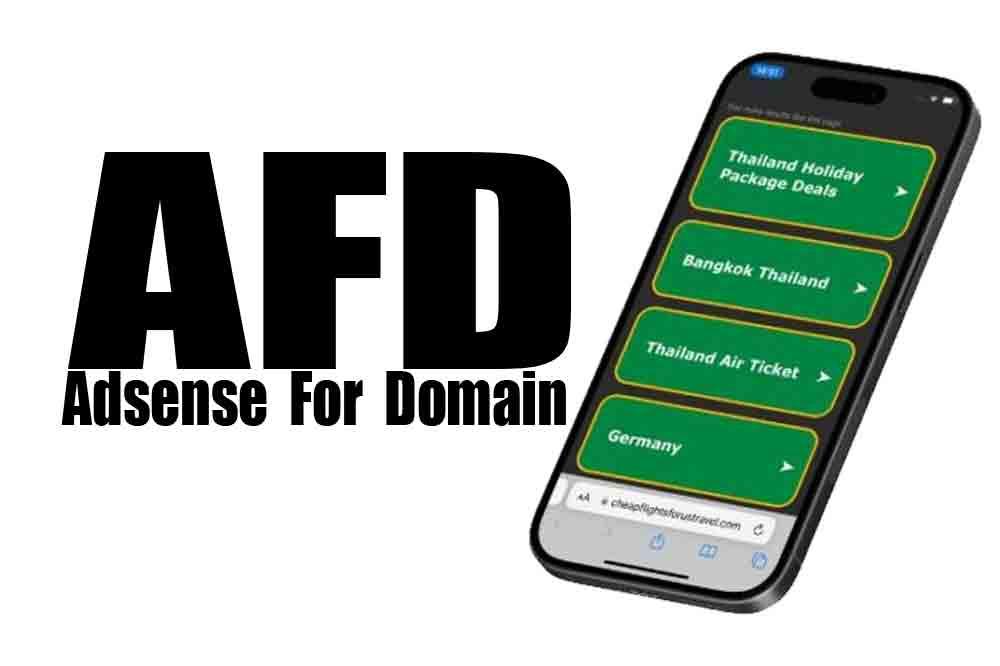
AFD (Ads for Domains) is a domain monetization technique that allows owners of undeveloped or unused domains to earn money by displaying relevant advertisements on those domains. Instead of letting a domain sit idle with no value, domain owners can “park” the domain with an AFD-supported provider and generate revenue from visitor clicks on ads.
In simple terms, AFD (Ads for Domains) turns unused domain traffic into passive income by matching ads to the domain’s topic and visitor intent.
AFD refers to a system where advertising networks place contextually relevant ads on parked domains. These ads are automatically generated based on factors such as:
Domain name keywords
Historical traffic patterns
Visitor location and intent
The domain owner earns a share of the revenue whenever a visitor clicks an ad.
Millions of registered domains are never developed into full websites. AFD exists to:
Monetize unused digital assets
Capture value from type-in traffic
Provide advertisers with additional ad inventory
Domain parking means pointing a domain’s DNS to an AFD provider instead of hosting a traditional website. Once parked:
A landing page with ads is displayed
The page requires no content creation
Ads are served automatically
AFD providers act as intermediaries between:
Domain owners
Advertising networks (often powered by Google or Bing)
They handle ad delivery, optimization, tracking, and payments.
AFD platforms use algorithms to determine:
Which ads best match the domain name
What ads are most likely to receive clicks
Higher relevance generally leads to higher click-through rates (CTR).
AFD primarily operates on a PPC (Pay-Per-Click) model. Domain owners earn money when:
A visitor clicks an ad
The advertiser pays the network
Revenue is shared with the domain owner
Most AFD providers split revenue between:
The advertising network
The AFD platform
The domain owner
Exact percentages vary by provider and traffic quality.
Expired domains with existing backlinks or residual traffic often perform well with AFD.
Domains like insurancequotes.com or traveldeals.net attract high-value ads due to commercial intent.
Some typo domains receive accidental traffic, which can still generate ad clicks—though compliance rules apply.
Once a domain is parked:
No ongoing maintenance is required
Revenue is generated automatically
Ideal for large domain portfolios
AFD requires:
No website design
No content writing
No SEO management
This makes it attractive for investors rather than developers.
Domains with little or no traffic may generate negligible income. AFD works best when:
Domains receive type-in traffic
Keywords have commercial value
AFD providers enforce strict rules:
No trademark infringement
No misleading domains
No artificial traffic
Violations can result in account suspension.
| Feature | AFD | AdSense |
|---|---|---|
| Website Required | No | Yes |
| Content Needed | No | Yes |
| Revenue Potential | Moderate | High (with traffic) |
| Setup Complexity | Low | Medium |
Affiliate sites require effort and content but offer higher long-term returns. AFD is ideal for:
Quick monetization
Holding domains before sale or development
Look for providers that offer:
Reliable payouts
Transparent reporting
Strong advertiser networks
Examples include domain registrars and specialized parking platforms.
Getting started usually involves:
Selecting a provider
Updating domain name servers
Choosing a parking template
Monitoring performance
Google’s advertising ecosystem plays a major role in domain ads. You can learn more about ad policies at
👉 https://support.google.com/adsense
Use clean, keyword-relevant domains
Avoid trademarked names
Test different ad layouts (if allowed)
Monitor CTR and RPM metrics
Rotate domains between providers if performance is weak
Yes, as long as the domain does not violate trademark or advertising policies.
Earnings vary widely—from cents per month to thousands for premium domains.
Generally no, and sometimes it adds value by proving traffic.
Yes, but results are better with existing traffic.
Yes. It requires minimal technical knowledge.
No. AFD is best for temporary or passive monetization, not long-term brand building.
AFD (Ads for Domains) is a simple yet effective way to monetize unused domains without building a website. By parking domains with an AFD provider, owners can generate passive income from relevant ads while holding, selling, or planning future development.
While it won’t replace full-scale website monetization, AFD remains a valuable strategy for domain investors and portfolio owners who want to turn idle domains into revenue-generating assets.